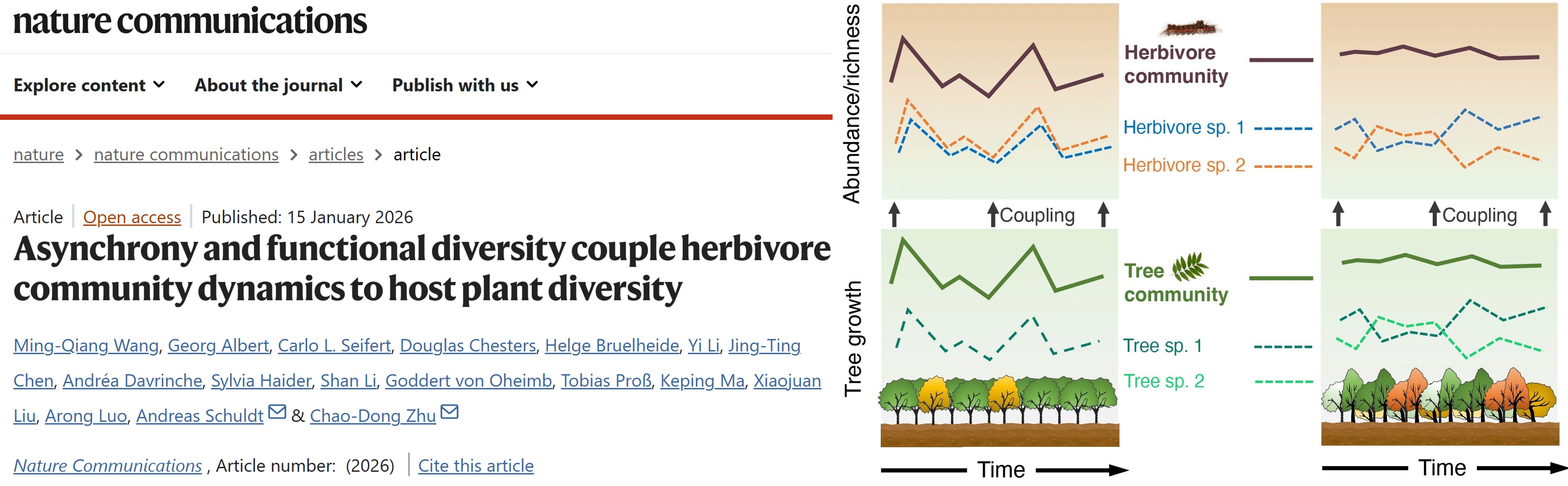
Biodiversity loss is widely recognized as a major threat to ecosystem functioning, yet how diversity–stability relationships propagate across trophic levels remains poorly understood. In forest ecosystems, insect herbivores form a critical link between primary producers and higher trophic levels, and instability in herbivore communities can trigger cascading effects, including pest outbreaks and forest dieback. However, the mechanisms by which host plant diversity and growth dynamics regulate herbivore community stability over time are still largely unresolved.
To address this gap, researchers from the Chengdu Institute of Biology, Chinese Academy of Sciences, together with international collaborators, analyzed a six-year time series of lepidopteran larvae and their host trees from the large-scale BEF-China tree biodiversity experiment. Using data from 52 forest plots spanning a gradient from monocultures to 24-species mixtures, the study examined how tree species richness, functional diversity, and temporal stability of tree growth interact to shape herbivore community dynamics. The authors explicitly disentangled multiple components of stability, including abundance asynchrony, population stability, and phylogenetic diversity, and assessed how these drivers differ between specialist and generalist herbivores.
The study reveals that herbivore community stability is primarily regulated indirectly by tree species richness. Rather than acting through direct effects, tree diversity influences herbivore dynamics via changes in tree functional diversity and the temporal stability of tree growth. These host-driven pathways, in turn, regulate herbivore phylogenetic diversity, abundance asynchrony, and population stability—key intra-community mechanisms that stabilize herbivore abundance and species richness over time.
Importantly, the effects of tree diversity strongly depended on herbivore dietary specialization. Tree species richness had clear stabilizing effects on the abundance and richness stability of specialist herbivores, mediated by enhanced tree growth asynchrony and increased herbivore phylogenetic diversity. In contrast, these stabilizing effects were absent for generalist herbivores. For the overall herbivore community, positive effects of tree diversity via tree growth asynchrony were partly offset by negative effects associated with higher tree functional diversity, resulting in less stable abundance dynamics at high tree richness.
Within herbivore communities, abundance asynchrony emerged as the dominant driver of temporal stability, highlighting the importance of compensatory dynamics among species. Herbivore phylogenetic diversity further promoted both asynchrony and population stability, particularly among specialists, suggesting that functional and evolutionary differentiation among herbivores enhances the buffering of temporal fluctuations.
Together, these findings demonstrate a strong bottom-up coupling between host tree diversity, tree growth dynamics, and herbivore community stability. The results emphasize that biodiversity loss at lower trophic levels can propagate upward to destabilize higher trophic levels, with specialist herbivores being especially vulnerable. From an applied perspective, the study suggests that biodiversity-oriented forest management, such as mixed-species plantations, may enhance the temporal stability of herbivore communities and reduce the risk of pest outbreaks, whereas monocultures may be more prone to instability driven by specialized herbivores.
This research provides one of the most comprehensive empirical tests to date of how diversity–stability relationships are linked across trophic levels in forest ecosystems, highlighting the importance of integrating temporal dynamics, functional diversity, and trophic interactions when predicting ecosystem responses to global change.
Funding
The study was supported by the National Key Research and Development Program of China, the National Natural Science Foundation of China, the Strategic Priority Research Program of the Chinese Academy of Sciences, international collaboration programs, and the German Research Foundation DFG within the MultiTroph research unit. MQW was supported by the Alexander von Humboldt Foundation.
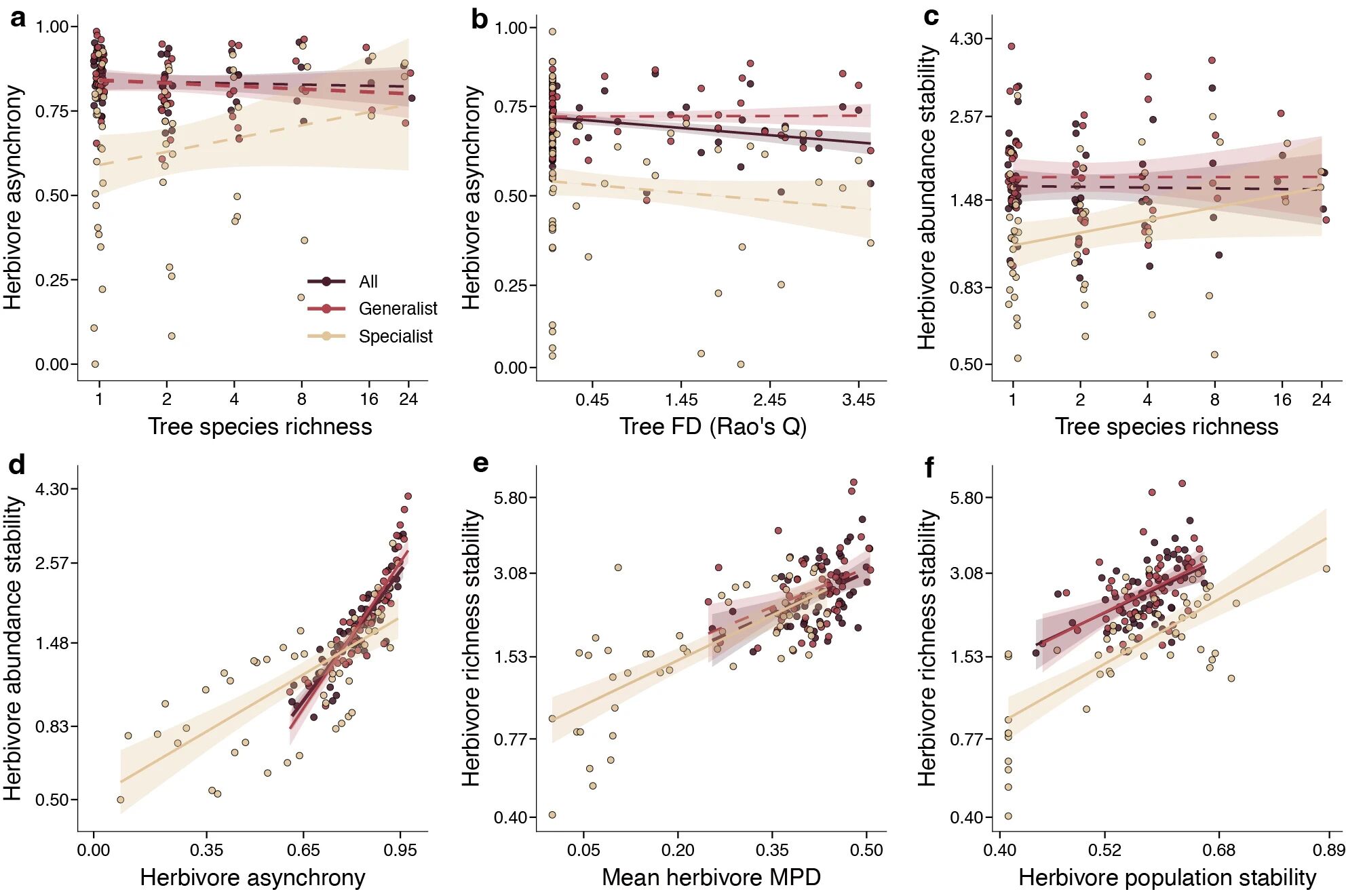
Figure 1. Bivariate relationships between herbivore stability, asynchrony, population stability, mean phylogenetic diversity (MPD) and tree species diversity based on linear model results.
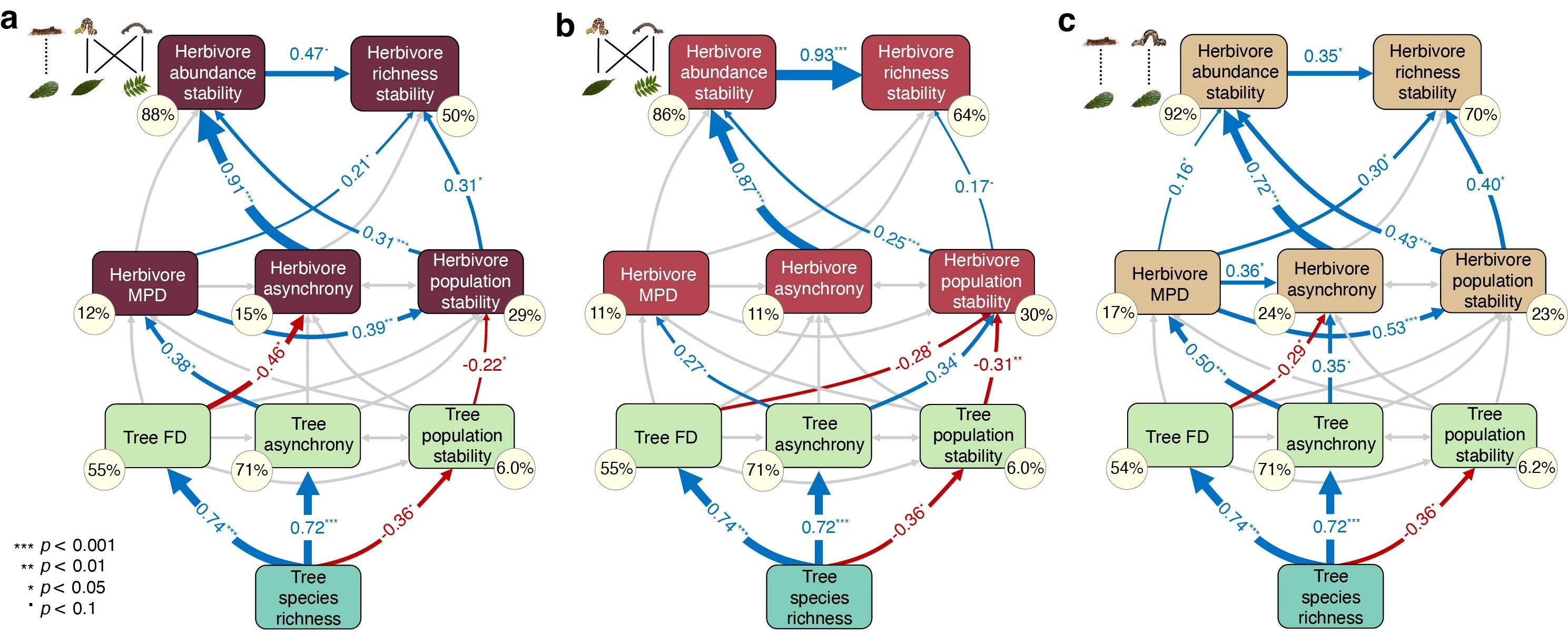
Figure 2. Effects of tree diversity on herbivore community stability via bottom-up regulation based on path model results.
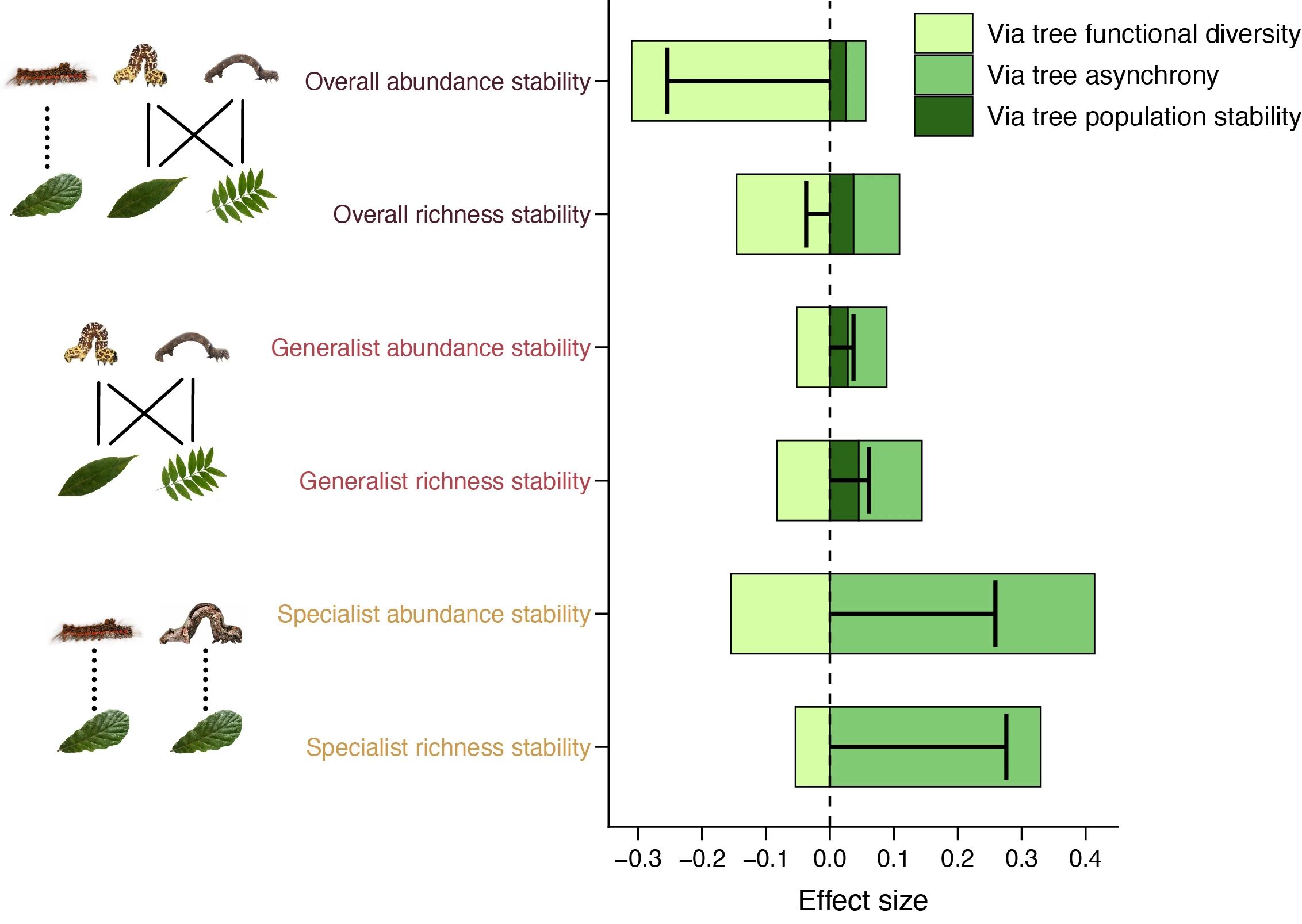
Figure 3. Effects of tree species richness on herbivore richness stability from path models.
Literature:
Ming-Qiang Wang, Georg Albert, Carlo L. Seifert, Douglas Chesters, Helge Bruelheide, Yi Li, Jing-Ting Chen, Andréa Davrinche, Sylvia Haider, Shan Li, Goddert von Oheimb, Tobias Proß, Keping Ma, Xiaojuan Liu, Arong Luo, Andreas Schuldt*, Chao-Dong Zhu*. 2026. Asynchrony and functional diversity couple herbivore community dynamics to host plant diversity. Nature Communications. 17:762. https://www.nature.com/articles/s41467-025-67990-0.