Saproxylic insect community assembly is structured by deadwood and forest habitat gradients, as well as biotic interactions such as competition, predation, and parasitism. However, co-variation between abiotic and biotic conditions limits our ability to disentangle their contributions. Furthermore, a focus on beetles in temperate and boreal forests has left important taxonomic and geographic knowledge gaps. Here, we tested how experimentally manipulated tree diversity, deadwood position (lying vs. standing), and biotic interactions with a dominant antagonist (ant exclusion) structure communities of deadwood-cavity-nesting bees, wasps, and their parasitoids in a subtropical forest. Lying deadwood supported less diverse and abundant communities than standing deadwood while retaining approximately twice as much moisture. Moreover, host emergence declined along moisture gradients within each deadwood type. Together, these patterns suggest that substrate moisture is an important factor limiting bee and wasp communities nesting in deadwood – reflecting reduced brood production, survival, or both – and is a candidate driver for their positive association with standing deadwood in forests. By contrast, neither ant exclusion nor observed ant occurrence was associated with host or parasitoid responses. Because standing deadwood is typically scarce in managed forests, our findings support retaining or creating standing deadwood structures alongside lying deadwood and, more broadly, promoting dry and elevated nesting substrates for cavity-nesting bees and wasps in conservation and restoration measures.
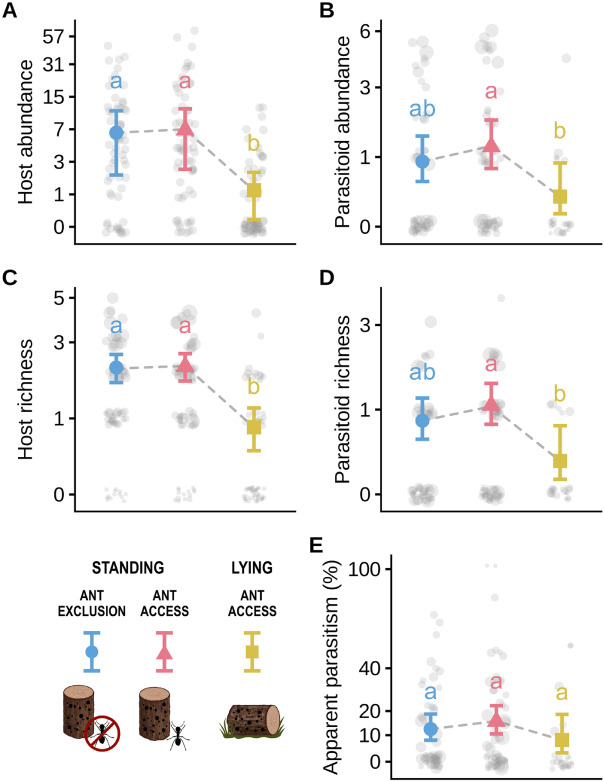
Figure 1. Saproxylic host (bees and wasps) and parasitoid abundance (A, B), species richness (C, D), and apparent parasitism rate (E) in standing deadwood with ant exclusion (blue circle), standing deadwood accessible to ants (red triangle), and deadwood lying on the ground (yellow square).
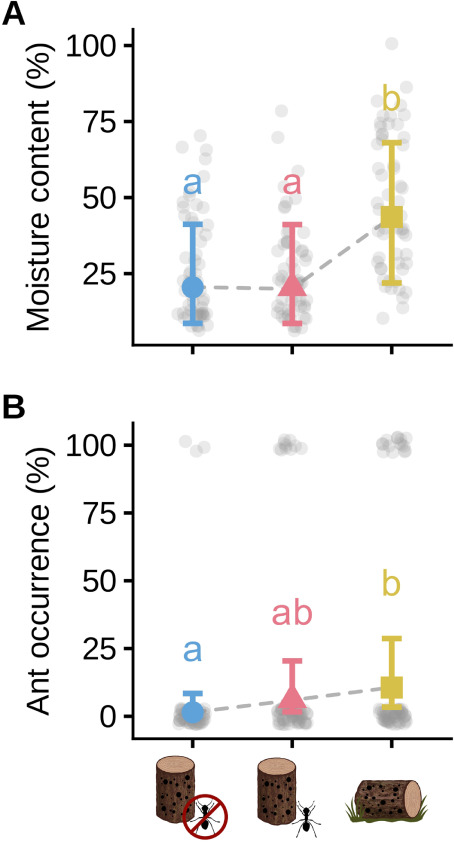
Figure 2. Relationships between standing deadwood with ant exclusion, standing deadwood accessible to ants, and lying deadwood on (A) gravimetric moisture content, and (B) probability of ant occurrence.
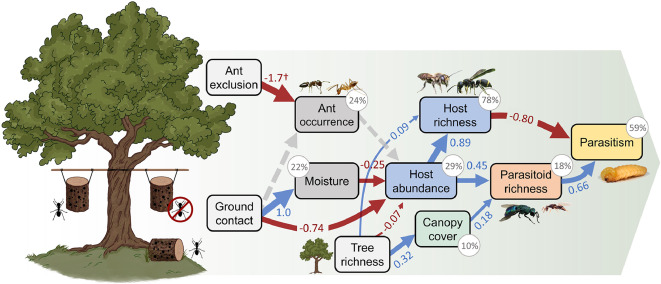
Figure 3. Parsimonious path model of direct and indirect effects of experimentally-manipulated deadwood treatment and tree richness on hosts, parasitoids, and apparent parasitism rate.
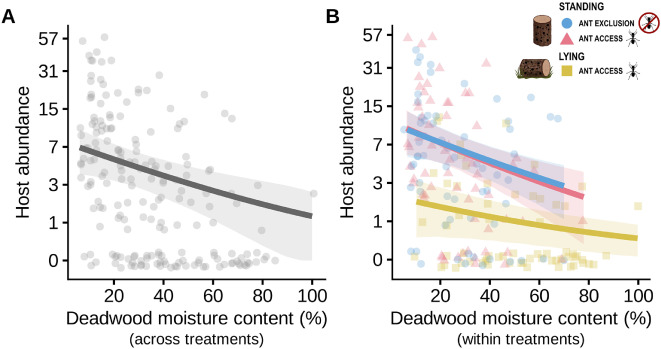
Figure 4. (A) across-treatments and (B) within-treatments marginal associations between deadwood moisture and abundance of cavity-nesting bees and wasps (after accounting for deadwood treatment).
Literature:
Massimo Martini*, Matteo Dadda, Felix Fornoff, Heike Feldhaar, Arong Luo, Finn Rehling, Joshua E. Spitz, Michael Staab, Simon Thorn, Chao-Dong Zhu, Alexandra-Maria Klein*. 2026. Moisture limits the diversity of nesting bees, wasps, and parasitoids in lying and standing deadwood. Basic and Applied Ecology. https://www.sciencedirect.com/science/article/pii/S1439179126000757?via%3Dihub
